General
*The game is based on the rules in the booklet “Kubb a game where everyone can participate” Where the basics mean that throws against the king are made with “normal” throws from the baseline and only by the that has knocked down all the fieldkubbs and the opponent’s basekubbs. No stacking or towers of thrown kubbs occur.
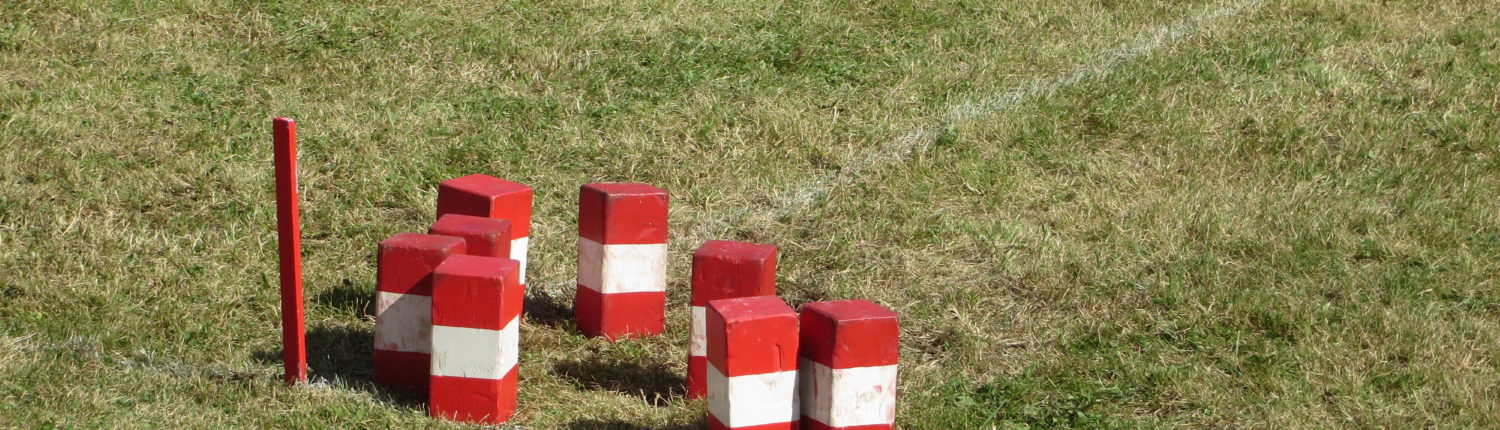
*The size of the field is 5×8 meters with lines along all outer edges and the center. When marking sticks are used, they must be placed in all corners and the center. These are not allowed to be completely removed at any time during the game.
*The team consists of six team members. If the team consists of fewer members, for example four, then only four sticks are thrown in the rounds when six sticks are to be thrown. The sticks must be distributed evenly among the team and a player may not throw more than one stick per round. If the team consists of more than six players, it is allowed to switch between rounds. Who in the team that will throw must be decided before each round. Tournaments with fewer participants per team are based on the same principle that the sticks must be distributed evenly.
*No player may participate in more than one team.
*The throwingsticks are 44mm in diameter and 30 cm long.
*The kubbs are 7×7 cm and 15 cm high.
*The king is 9,5×9,5 cm and 30 cm high.
*In the event of unsportsmanlike behavior by a player, the referee will give a warning and if the player does not behave, the player will be removed from the game and the team will lose a throwingstick. In the event of unsportsmanlike behavior by the entire team, the referee will give a warning and if the team does not behave, they will be judged as the loser of the game. Unsportsmanlike behavior can include, for example, psyching up and repeated violations of the rules.
How to start the game
*First, both teams decide how the sticks will be thrown. Either the starting team throws all 6 sticks from the start or they throw 2-4-6. If the teams cannot agree, 2-4-6 applies. 2-4-6 means that the team that starts with the sticks throws only 2 sticks, when the next team is to throw, the team throws 4 sticks and then 6 sticks apply until it is time for a new set, then the procedure starts again.
*Which team starts throwing? After the teams have decided how the sticks will be thrown, the teams decide which team will start with the sticks. This is done by throwing one stick from each baseline at the same time towards the king. The team that comes closest to the king without knocking it down (the stick may touch the king but not knock it down) gets to choose first. It is the end of the stick that counts when it comes to which stick is closest. Either the team chooses to start with the sticks or which side they want to start throwing from. If the team chooses a side, the other team gets to start with the sticks and vice versa.
Throw the sticks
*The throwingsticks may only be thrown with an underhand throw and with the stick along the throwing direction, so called helicopterthrows are prohibited.
*A throw is considered a helicopterthrow if the stick rotates more than 30 degrees horizontally before it hits anything, including the ground. The horizontal angle is counted from where the player releases the stick. However, if the stick rotates vertically, it is fully approved. A throw is counted when the thrown stick lies with at least half the stick past the current throwing line.
*If a throw is ruled out, the kubb/kubbs must be raised again. Fieldkubbs must be placed back where they were before the throw as similar as possible. The throw is then used up and the next player throws.
*Overstepping. Both feet must be completely behind the current throwing line and inside the side lines at the start of the throw. When a team is allowed to step forward and throw, the back corner of the kubb is considered the throwing line. In connection with the throw, no step may be taken forward over the throwing line or past the side line at all. If this happens, the throw is considered overstepping and is ruled out. This also applies to the hand or other body part. The player can, for example, put a hand on the ground for support after the throw, which is considered overstepping. Both feet on the ground behind/inside the lines and stand still before it is ok to step on “forbidden ground”. Jumping and throwing is not allowed. It is allowed to lean forward when throwing and thus stand on only one leg, the leg that is in the air can be outside the side line but must be out down inside. Players may not use other players or objects to lean or prevent overstepping.
*For wheelchair-boound throwers, the center of the wheels counts as feet.
*The non-throwing team must be at least 2 meters behind their own baseline when the opposing team throws.
*Kubbs may not be moved out of position to allow the thrower to have a better throwing position.
*It is not permitted to go to another playing field to practice throwing during a match.
*Where matches are played with strings as lines, these must be immediately corrected if they have been thrown out of position by a stick or kubb. Both teams must work together to ensure that the positioning is correct.
Throwing in and raising kubbs.
*When throwing in fieldkubbs, all current kubbs are first thrown, then those that are then invalid are thrown again. If any kubbs is invalid after the second round, these kubbs become penalty kubbs. Players can both push kubbs in and out with the help of other kubbs. The team therefore only has 2 rounds to throw in the kubbs, not two per kubb.
*Kubbs are allowed to land outside the field and on their own half of the field, but must stay on the correct side to be valid. If the kubbs hits a previously placed fieldkubb, it is raised where it stops after the hit.
*Overstepping. The same principle for overstepping applies here as when the player throws a stick. See above.
* The kubbs may be thrown sideways but still only with an underhand throw, all kubbs must be thrown from the baseline.
*The kubbs may be thrown by whoever wishes, players may therefore switch at the second throw or in the middle of a round. This does not apply to tournaments where the kubbs are distributed evenly or divided per round. Then each player has his own round or kubbs to throw.
*Kubbs thar are knocked over and stand up again are counted as knocked down. To be counted as knocked down, all four corners must have left the ground. A kubb that, after being hit, lifts all 4 corners off the ground and stands up on the same 4 corners again without rotating is not counted as knocked down.
*Kubbs that are pushed outside the playing field without falling are pushed back immediately after the throw so that the entire kubb is inside the line.
*Kubbs that are knocked down by mistake are simply raised up again. Should the team, for example accidentally throw down their own fieldkubb or basekubb, these are simply raised up again. This does not apply to the king.
*A penalty kubb may not be placed closer to the king or marking sticks than the length of a throwing stick. To measure this, only the sticks and never the king are used.
*Raising kubbs. Kubbs are raised over a straight edge, i.e. 2 corners in the ground. When raising, it is not permitted to test back and forth which is most advantageous. Should a kubb lie on only one corner side, the block is raised straight along this side.
*When the kubbs are in a pile, you must start raising the kubbs that lie on top and those that lean towards another kubb. Those that lie on top are moved over the nearest edge, leaning kubbs must be set up where it already has corners in the ground. If a kubb leans on top of others and thus has one end completely free and the other towards another kubb instead of towards the ground, the kubb is first placed horizontally over the lying kubbs and then moved over to the nearest edge. If there is room for the the entire kubb between the two lying kubbs, the “hanging” kubb should be placed there.
*Kubb may be raised even if they are in direct contact with each other. This is done lying down against a standing kubb i.e. one kubb at the time. However, the kubb must first be raised against the surface where the entire kubb can fit. Should one of the kubbs be invalid after they have been forced up against each other, it is invalid.
*The entire kubb must be inside the lines after is has been raised to be considered valid.
*When a game is played with strings as lines, the kubb is allowed to touch the string when the kubb is tilting as long as it does not move the string out of position. The string must always be corrected as soon as they are out of position.
*A kubb that, after being raised, tilts too much to stand due to uneven ground or tilts and pushes the string out of position is allowed to be supported with grass or similar under the kubb.
*A kubb that, after being thrown down, leans against a kubb/king, throwing stick or marking stick may be checked to see if it has been knocked down directly. This is done by the referee in the first instance, otherwise by the defending team in consultation with the thrower.
*A kubb that is hit by a stick but does not fall is counted as down if it falls at any time during the round. No time limit applies, however, sportmanship must be maintained. After the last stick is thrown, the defending team may correct the kubbs.
*If a thrown stick hits the last fieldkubb and a basekubb in the same throw, both are counted as down regardless of which kubb falls first. *To speed up the game, a maximum of 2 players may raise the fieldkubbs when raising them, but they may be switched after each round.
Throw against the King
*Wood against wood applies if the king is knocked down by mistake. If the king is knocked down when it should not be knocked down regardless of location, stick or kubb, the set/match is lost even if an overstep occurs.
*The king must always be knocked down from the baseline.
*The king must be knocked down with a single throw.
*The king may be corrected between rounds of throwing.
*In the event of an overstep, the throw is invalid and the game continues.
Tiebreak
All matches in WC except finals on Saturday has a start and stop time as will be announced in the PA system. It is aloud to start the match before the start time i s announced if both teams agree. If the match is still tied when the stop time is announced the match will proceed to Tiebreak. You can find instructions for Tiebreak below and also on the game schedule at your fields.
Time limit before Tiebreak starts:
- Group stage Friday: 90 minutes (best of 3 set)
- Lilla VM Friday: 30 minutes (best of 1 set)
- Group stage Saturday: 75 minuter (best of 3 set)
- Lilla VM Saturday: 30 minutes (best of 1 set)
- Knock out stage Saturday: 90 minutes (best of 3 set)
- Semifinal and final Saturday: No time limit (best of 3 set)
Tiebreak instructions:
When it is time for a Tiebreak, the team that is throwing a round must finish it first. A new round starts when the first kubb is thrown. To start a tiebreak, you need to do the following steps:
1. The teams throw closest to the king as you do in the beginning of the game, the winner of the closest to the king (Team A) wins the advantage in the tiebreak.
1.1 The advantage from the Tiebreak starts from the first round that the team (Team A) is allowed to throw, even if the team is not allowed to throw until the following set.
1.2 The first tiebreak kubb is removed from play after the thrown kubbs are raised after Team A’s first round of the tiebreak.
1.3 The kubb closest to the baseline is always removed (if any base kubbs remain, they must be removed before field kubbs. The base kubb furthest from the field kubbs is removed first.)
1.4 After Team A’s first round of the tiebreak, one kubb is removed each round from the opponent’s half of the field after the kubbs have been thrown in. This continues until the end of the game.
Knockout Kubb
Knockout kubb instructions:
In the event that two or more teams finish on the same points after the group stage is complete, the set difference is counted first and then the head-to-head match. Should the teams still be tied after this, a Knockout is held, supervised by a referee/official. This is done as follows:
1. The starting order is random by drawing lots conducted by the referee.
2. The team that starts throws in 5 kubbs that the referee then raises.
3. Now the team throws their sticks to get the 5 field kubbs down, if they succeed in this, the team continues to throw at the base kubbs.
4. The winner is the team that firstly has thrown down the highest number of base kubbs and secondly the number of sticks it took to get the 5 field kubbs down. If a team does not knock down the 5 field kubbs, the number of kubbs the team has got down after the 6 sticks is counted.
5. Should the teams throw exactly the same result, they throw again until a winner is determined.
 1: King, 2: Kubbs, 3: Throwing batons, 4: Corner stick, 5: Baseline